menu
menu
Critical Role in Clinical Laboratories
Hospital labs are central to diagnosis, monitoring, and research – test accuracy directly affects clinical decisions and patient safety. Ultra-pure water is an essential utility, widely used in:
Clinical biochemistry and immunoassays
Microbiological culture and molecular diagnostics
Pathology slide preparation and hematology testing
High-quality ultra-pure water minimizes interference, ensures data precision, and improves diagnostic reliability – in full compliance with GB/T 6682-2008 (Water for analytical laboratory use).
High-Purity Water System for Hospital Clinical Laboratories
What Is Ultra-Pure Water?
Ultra-pure water goes beyond ordinary pure water by reducing:
Electrical conductivity (nearly complete removal of ionic species)
Colloids, dissolved gases, organics, and microorganisms to trace levels
Producing such water requires at least two advanced techniques (e.g., RO + EDI + ion exchange + ultrafiltration), combined through scientific process design and stringent quality control – ensuring no impurities compromise test results.
RO + EDI ultra-pure water system
ion exchange water purifier for clinical lab
multi-stage laboratory water purification
ultra-pure water for biochemistry analyzer
water system for immunoassay laboratory
low TOC ultra-pure water for HPLC
bacteria-free water for molecular diagnostics
GB/T 6682-2008 compliant lab water system
1. Multi-Stage Purification for Compliant Water Quality
Our system uses a proven combination of processes:
Pretreatment → Reverse Osmosis (RO) → Ion Exchange → Advanced Polishing
It integrates microfiltration, ultrafiltration, RO, EDI, and ion exchange to progressively remove:
Sediment, particulates, and colloids
Microorganisms and organic matter
Heavy metals and dissolved inorganic salts
This ensures water quality meets the strict requirements of all clinical lab tests and high-end analytical instruments.
2. Precision Pretreatment – Protecting Downstream Components
Tap water first passes through a precision sediment filter and activated carbon cartridge. This step:
Removes suspended solids, sand, colloids, and microbes
Adsorbs odors, residual chlorine, and some organics
This protects the RO membrane and ion-exchange resins from fouling or clogging, extends their service life, ensures stable long-term operation, and reduces maintenance costs.
3. High-Efficiency Reverse Osmosis – Deep Purification
Pretreated water enters the high-performance RO unit. The semipermeable membrane effectively rejects:
Most inorganic salts (including heavy metals)
Organics, bacteria, viruses, and pyrogens
Only water molecules pass through, achieving deep purification and providing a solid foundation for the final polishing steps.
4. Advanced Ion Removal – Customizable for Specific Needs
Purified water is stored in a dedicated tank, then passed through a high-precision ion-exchange system to remove residual ions:
Anion resin – removes chlorides, nitrates, sulfates, etc.
Cation resin – removes sodium, calcium, magnesium, etc.
The system can be adjusted to meet special experimental requirements, ensuring final water quality fully complies with applicable standards.
5. Our System – Tailored for Full-Lab Applications
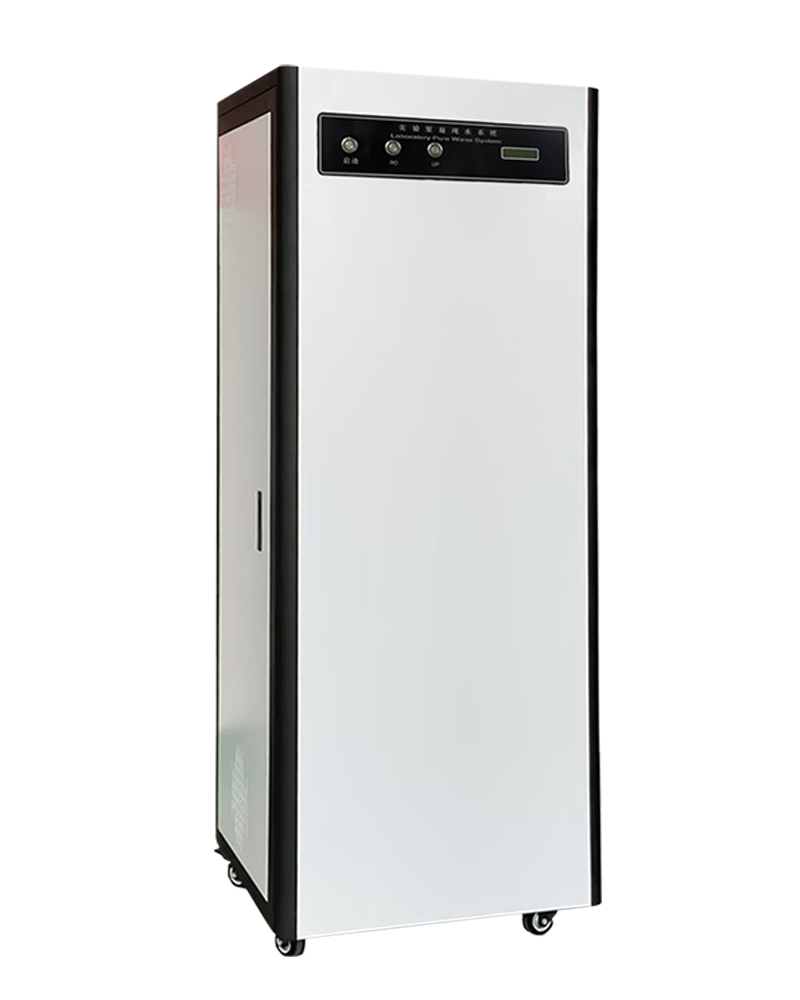
Our ultra-pure water system is specifically designed for hospital clinical laboratories, supporting all key workflows:
Sample preparation and reagent formulation
Instrument rinsing and reaction media
Calibration and analytical runs
It reliably serves routine tests as well as demanding instruments such as:
HPLC and mass spectrometers
Gene sequencers and other advanced platforms
By delivering stable, high-purity water, our system helps laboratories enhance efficiency, improve data accuracy, and provide a solid foundation for clinical decision-making.